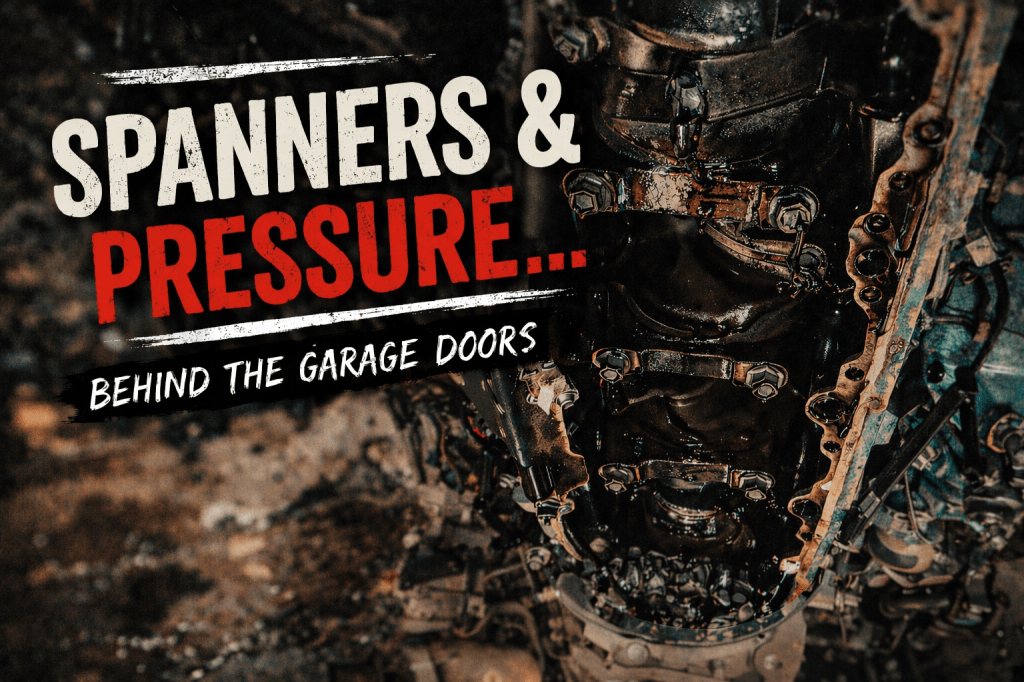
This is the first post in the “Spanners & Pressure… Behind the Garage Doors” series.
The Weight You Never See
Before anything else, before the stories begin and before the moments that stay with you long after the job’s done, this needs a starting point. Call it a crawl before the first gear fully engages. Because this isn’t just another blog series. It’s something different. It’s a look into a world most people pass every single day without giving it a second thought. A world hidden behind shutter doors, workshop walls, and the constant noise of tools hitting metal. A world where the job doesn’t end when the tools are put down, and the responsibility doesn’t stay behind when you go home.
This series is exactly what the title suggests. Spanners and pressure. Not just the physical side of the job, not just the graft, the grease, or the long hours, but the kind of pressure you don’t see. The kind that sits quietly in the background, always there, shaping every decision, every check, every moment you think a job is finished. It doesn’t shout. It doesn’t show off. But it never really leaves you.
I work as an HGV mechanic. Heavy goods vehicles. The big machines that move everything around us, whether people realise it or not. They keep shelves stocked, deliveries moving, businesses running.
Let me put it this way. Everything you own, eat, see, and feel has taken a ride on a truck at some point. Every brick in the house you live in, your sofa, your TV, your PlayStation, your Xbox, your phone, even the device you’re reading this on, your car… even the damn kitchen sink. It’s all been on a truck at some point. Even the truck carrying everything had to be delivered once… on a damn truck, even if that is just the parts.
There’s potential for a paradox in that, isn’t there?
They’re part of everyday life, just passing by in the background while everyone else gets on with their day. But working on them is different. The stakes are higher. The margin for error is smaller. And the consequences, if something goes wrong, don’t always give you a second chance.
They’re part of everyday life, just passing by in the background while everyone else gets on with their day. But working on them is different. The stakes are higher. The margin for error is smaller. And the consequences, if something goes wrong, don’t always give you a second chance.
That’s what this series is about. Not the surface level. Not the quick fixes or the easy stories. This is about going deeper into what it really means to work in this world. The pressure that comes with it. The responsibility that sits behind every job. The thoughts that follow you home, whether you want them to or not. The moments people don’t see, and probably wouldn’t think about even if they did.
This isn’t going to be a scheduled series, because that wouldn’t make sense for the kind of life it’s coming from. There’s no neat structure to this job. Some days pass without anything worth saying, and other days leave something sitting in your head that won’t go away until you get it out. That’s how this will work. No set day, no forced posts. Just real moments, written when they happen, not when they’re expected.
And it won’t just be my voice either. Over time, this will grow beyond just one perspective. There are mechanics, drivers, and people all around this industry who carry their own version of this pressure. Different roles, different experiences, but all connected by the same roads, the same machines, and the same understanding that what we do matters more than most people realise. Their stories deserve to be heard just as much.
There is something important that needs to be made clear from the beginning. Any stories shared here, whether they come from me or from others, will be protected. Names will be changed. Places will be changed. Dates will be altered. Details may shift where needed to make sure no one can be identified. Some stories may be completely true. Some may be adapted. Some may sit somewhere in between. But none of them, in any form, are to be used against anyone at any time. That line matters, and it will not be crossed.
This series isn’t about exposing people. It’s about showing the reality of a job that exists quietly in the background, carrying more responsibility than it’s ever given credit for. It’s about giving a glimpse into what happens behind those garage doors, where decisions are made that don’t just affect machines, but the people around them.
If you’ve never stepped into a workshop, never stood beneath something that weighs more than you can really comprehend, never had to make a call knowing what could happen if you get it wrong, then this is your way in. And if you have, then you already understand what this is.
This is just putting it into words.
This is the crawl before the gears start turning.
And once they do, it doesn’t stay quiet for long.
When Things Go Wrong
There’s no big warning when something goes wrong. No dramatic build-up, no moment where everything slows down and gives you time to react. It happens in the same world as everything else, in the middle of normal traffic, on a road full of people just getting on with their day. And by the time anyone realises something isn’t right, it’s already happening. Already moving. Already out of anyone’s control.
A truck leaving the workshop is just another vehicle to most people. It blends into the background. It sits in the left lane, steady, predictable, easy to ignore. You drive past it without thinking, or sit alongside it without a second thought. It’s just there, part of the road, part of the routine. But what people don’t see is what that vehicle actually is once it’s up to speed. Not just a machine, but tonnes of moving weight, momentum building with every mile, something that doesn’t stop or change direction the way a car does. It carries on. It pushes forward. And when something fails, it doesn’t fail quietly.
Take something as simple as a wheel. Most people never think about it. It’s just there, doing what it’s supposed to do. But if something isn’t right, if something hasn’t been tightened properly, if something has been missed, that wheel doesn’t just drop off and sit politely at the side of the road. At motorway speed, it becomes something else entirely. It separates with force, hits the road, and keeps going. Bouncing, rolling, unpredictable, carrying energy that has to go somewhere. It doesn’t choose a direction. It doesn’t slow down because someone needs it to. It moves until something stops it, and whatever that something is, takes the hit.
And there’s no controlling that. No calling it back. No second chance to fix it once it’s already gone.
Then there’s braking systems. Something people trust without even thinking about it. You press the pedal, and the vehicle stops. It’s one of the most basic expectations of driving. But when that system fails on something the size and weight of an HGV, it’s not just a minor issue. It doesn’t just “struggle to stop.” It keeps going. Forward, no matter what’s in front of it. Traffic, barriers, open road, it doesn’t matter. That kind of weight doesn’t just come to a halt because it should. It takes distance, time, and control. And if that control is gone, then everything in its path becomes part of the problem.
People think of motorways as safe because they’re controlled. Lanes, barriers, and central reservations are all designed to keep things moving and separated. But those systems rely on vehicles behaving how they’re supposed to. When something that heavy doesn’t, those layers of safety start to feel a lot thinner. A central reservation isn’t a guarantee. It’s a line, not a wall. And when momentum is involved, lines can be crossed.
That’s the reality that sits behind it all. Not the headlines you might read after something happens, not the short version people talk about after the fact, but the actual moment when control disappears, and nothing can be done to pull it back. It’s not loud and dramatic like people imagine. It’s fast, messy, and unforgiving. One second, everything is normal, the next it isn’t, and there’s no time in between to fix it.
And that’s the part that stays with you.
Because none of this exists in isolation. It all traces back to a moment, a decision, a job that was signed off as done. Every bolt, every system, every part that was checked, or wasn’t. Not in a dramatic, blame-driven way, but in a real, unavoidable sense of cause and effect. What happens out there starts somewhere in here.
So when you’re working on something like that, you don’t think in terms of “that’ll do.” You don’t rush just to get it out the door. Because you know how quickly normal can turn into something else. You know how little it takes for control to disappear once it’s left your hands.
And once it’s out there, that’s it.
No going back. No second look. No chance to tighten something you thought was fine the first time.
Just the quiet understanding that whatever happens next, happens without you.
And when things go wrong, they don’t stay small for long.
The Name on the Line
There’s a moment at the end of every job that doesn’t look like much from the outside.
No noise. No tools. No pressure in the way people would expect. Just a form, a screen, a signature. A quiet confirmation that the work is done and the vehicle is safe to go back out on the road.
But that moment carries more than anything that came before it.
Because up until then, everything is in your control. You can stop, check again, take something apart, and redo it if it doesn’t feel right. You can question yourself, take your time, and go over it as many times as you need. The job is still yours to manage.
That signature is the line where it stops being yours.
When you sign something off, you’re not just saying the job is complete. You’re saying you stand by it. You’re saying that everything you’ve touched, checked, tightened, or assessed is exactly how it should be. If that truck goes back out onto the road, it does so safely.
And that sounds simple.
It looks simple.
But it isn’t.
Because that one action connects you to everything that happens after it leaves. Every mile it drives, every road it travels, every situation it ends up in. Not in a way people would notice day to day, but in a way that becomes very real the moment something goes wrong.
If that truck is involved in an accident, whether it’s the driver’s fault or not, whether it’s unavoidable or not, the vehicle doesn’t just get ignored. It gets checked. Properly checked. Every system, every component, every part that could have played a role gets looked at, taken apart, and questioned.
And if something isn’t right, it doesn’t stop at the vehicle.
It comes back to the work.
Back to the decisions.
Back to the person who said it was safe.
That’s the part most people never see. The part where a job doesn’t just end when the truck leaves the workshop. It stays attached to it, quietly, in the background. Waiting, not in a constant state of fear, but in a constant state of accountability.
Because mistakes don’t need to be big to matter.
They don’t need to be obvious.
Sometimes it’s something small. Something that seemed fine at the time. Something that didn’t stand out in the moment, but becomes everything when it’s looked at later, piece by piece, under a different light.
And that’s what sits behind that signature.
Not panic or doubt. Just the understanding that once you’ve put your name to it, there’s no taking it back. No stepping in later to fix something if it turns out not to be right. No chance to say you’ll sort it tomorrow.
It’s done.
It’s out there.
And your name is on it.
That’s the weight most people never see.
The Pressure That Stays With You
There’s a version of this job people see, and then there’s the version you live with.
On the surface, it looks straightforward. Fix it, check it, move on to the next one. Another truck in, another truck out. Dirty hands, long hours, maybe a bit of graft, and that’s about as far as most people take it. And to be fair, on the outside, that’s all there is to see.
But what doesn’t get seen is what stays behind once the job’s done.
Because the pressure doesn’t sit in the moment you’re working. It follows you. It lingers in ways that don’t really announce itself or demand attention, but it also never quite switches off either. It’s there in the background, woven into how you think, how you work, how you carry yourself even when you’ve left the workshop.
You can finish a job, clean up, head home, and sit down like anyone else would after a long day. But your mind doesn’t always come with you straight away. It drifts back without asking. Replays things you’ve already done. Runs through checks you’ve already made. Not because you didn’t do them properly, but because you understand what they mean.
You’ll be lying there at night, and something small will creep in. A thought you didn’t ask for. Was that exactly how it should have been? Did I check that twice or just once? It’s not panic, it’s not even doubt in the way people imagine it. It’s awareness. The kind that builds over time, job after job, until it becomes part of how you think.
And that awareness comes from knowing what’s at stake.
Not just the vehicle, not just the job, but everything connected to it. The driver sitting behind the wheel for hours on end, trusting that what they’re driving is safe. The people sharing the road with it, who don’t even realise they’re relying on the work that’s been done before that truck ever reached them. The distance that the vehicle will cover, the environments it will move through, and the situations it will end up in.
Drivers carry their own version of this, too. They’re the ones out there, mile after mile, dealing with roads, traffic, weather, pressure from schedules, pressure from time, all while handling something that doesn’t forgive mistakes easily. They trust the machine they’re in, but they also feel every change in it. Every sound, every vibration, every difference that doesn’t feel right. And when something is off, they’re the first ones to know it.
There’s a relationship there that most people never see. Between the person who works on the vehicle and the person who drives it. It’s not spoken about, it’s not written down anywhere, but it exists. One puts the work in behind closed doors, the other takes it out into the world. Both carrying responsibility in different ways, both relying on each other without ever really saying it.
And that’s where the respect comes from.
Because this isn’t just about fixing things or driving from one place to another. It’s about understanding the weight behind it. The pressure that doesn’t disappear when the job’s done or the engine’s switched off. The quiet responsibility that sits with you, whether you’re in the workshop or miles away from it.
It’s easy to overlook that from the outside. Easy to see a truck as just another vehicle, a mechanic as just another job. But when you start to understand what’s behind it, when you start to see the layers that sit under something that looks so simple, it changes how you look at it.
It stops being background noise.
It becomes something you notice.
And once you notice it, you don’t really unsee it.
Why Nothing Is Ever “Just Done”
There’s a reason nothing in this job ever feels finished, the moment it looks finished. You can follow the process, tick every box, do everything by the book, and from the outside, that should be enough. That should be the point where you move on, wipe your hands, and don’t give it another thought. But it never really ends there.
Experience changes how you see things. Not in a dramatic way, not even overnight, but gradually, job after job, until the way you think shifts without you even noticing. You start to understand that things don’t always go wrong where you expect them to. It’s rarely the obvious faults or the big failures people imagine. More often, it’s something small, something that didn’t stand out at the time, something that felt fine in the moment but doesn’t feel quite the same when you think back on it later. And once you’ve seen that enough times, it stays with you.
That’s where “that’ll do” quietly disappears from your mindset. Not because you’re trying to be perfect, and not because you’re slowing everything down for the sake of it, but because you’ve learned what’s at stake if you get it wrong. You find yourself pausing for a second longer than you need to, looking at something you’ve already done, not because it looks wrong, but because you want to be sure it isn’t. It’s not doubt in the way people might think. It’s awareness. The kind that sits in the background and nudges you just enough to take another look.
From the outside, that moment probably looks unnecessary. It might even look like overthinking something simple. But on this side of the garage doors, there’s always a reason for it. You’re not just working through a job to get to the end of it. You’re working on something that’s about to leave your control completely, something that won’t give you the chance to step back in later if something doesn’t feel right. Once it goes, it’s gone, and whatever happens after that unfolds without you, but also potentially because of you.
That’s why the extra time matters, not in a dramatic sense, but in a quiet, steady way that builds confidence in what you’ve done. It’s the difference between finishing a job and being sure of it, between hoping everything is right and knowing that you’ve done everything you can to make it so. That difference might not mean much to anyone watching from the outside, but it means everything when you’re the one putting your name to it.
Drivers feel the result of that, even if they never see the process behind it. They get in, turn the key, and expect the vehicle to respond exactly how it should. And when it does, when everything feels right, that trust builds without a word being said. It’s quiet, almost invisible, but it’s there all the same. It’s what allows them to focus on the road ahead without questioning what’s happening underneath them.
That’s what keeps everything moving. Not speed or shortcuts, and not the rush to get things out the door, but the care that sits behind it all. The consistency that comes from knowing what the job really carries, even when no one else sees it.
Because the moment you step away isn’t just the end of a job.
It’s the point where it leaves your hands completely.
And from there… whatever happens next belongs to the road.
The Walk Away
There’s always a point where the job ends, even if it doesn’t look like much from the outside.
You step back, take a look, and everything appears exactly as it should. No noise, no movement, just a finished piece of work sitting there waiting for its next run. To anyone else, that would be the end of it. A clean break between one job and the next.
But for you, it’s not a clean break. It’s a shift.
Up until that moment, everything has been within reach. Every decision, every adjustment, every check has been yours to make. You’ve had the time and the space to work through it properly, to be certain of what you’re leaving behind. That control is part of the job, and it stays with you right up until the point you step away.
After that, it changes.
What you’ve worked on is no longer something you can influence. It’s no longer something you can return to on a whim or tweak if a thought crosses your mind later on. It moves from being something you’re responsible for in the moment to something that exists beyond you, out in a world that doesn’t pause or wait.
That’s the real separation.
Not physical distance, but the understanding that your part is complete.
Drivers step into that space from the other side. They don’t see the process that led up to it, but they take over the outcome. The first few miles tell them what they need to know. The feel of the vehicle, the way it responds, the way everything settles once it’s moving again. It’s a different kind of awareness, but it comes from the same place.
There’s no conversation between those two points, no formal exchange, but something passes between them all the same. One person leaves their work behind, another carries it forward.
From the outside, it’s just a vehicle leaving a workshop.
From the inside, it’s the moment where responsibility changes hands.
And once it does, there’s nothing left to add, nothing left to take away.
Only the road ahead, and whatever it brings with it.
What You’ll See Next Time
You won’t notice the exact moment it changes. There won’t be a switch that flips or a sudden realisation that stops you mid-journey. It will be quieter than that. The kind of shift that settles in slowly, until one day you realise you’re looking at something familiar in a completely different way.
You’ll be on the road, same as always. Same route, same traffic, same rhythm of getting from one place to another. And there’ll be a truck in front of you, or beside you, or easing past in the next lane. Just another part of the road, the way it’s always been. But this time, something will feel different. Not enough to stop you in your tracks, just enough to catch your attention for a second longer than usual.
You’ll still see the size of it, the weight of it, the way it moves through traffic, but there’ll be something else behind that now. Not fear, not even concern, just an awareness that wasn’t there before. An understanding that what you’re looking at isn’t just a machine doing a job. It’s something that’s been through hands you’ll never see, decisions you’ll never hear about, checks you’ll never witness. There’s a story behind it, even if you never know the details.
That story doesn’t stay behind when the truck leaves the workshop. It travels with it. Every mile it covers, every junction it passes, every moment it shares the road with everything around it. That quiet chain of responsibility doesn’t disappear just because it’s out of sight. It carries on, unnoticed, doing exactly what it’s meant to do when everything has been done right.
You might find yourself giving it a bit more space without really thinking about why. Not out of fear, but out of a quiet respect for what it is and what it represents. You might notice the way it holds its lane, the way it moves, the way it responds to the road, in a way you never paid attention to before. Nothing dramatic, nothing exaggerated, just a shift in awareness that stays with you.
And maybe you’ll think about the person behind the wheel as well. The hours they put in, the roads they cover, the way they handle something that doesn’t forgive mistakes easily. They rely on everything working exactly as it should, without ever seeing the work that made it that way. There’s a trust there, unspoken but constant, built on the understanding that what’s been done behind the scenes is holding up out there where it matters.
There’s a connection in all of this that most people never see. Between the ones who work on these machines and the ones who take them out into the world. Different roles, different pressures, but part of the same chain. One prepares it, the other carries it forward, and everything in between depends on both of them doing what they do properly.
Most of the time, none of this stands out. When everything works, it all fades into the background, exactly as it should. The truck moves, the road flows, and people get where they’re going without thinking twice about any of it. That’s the goal. Not recognition, not attention, just the quiet confidence that everything is working the way it should.
But now there’s something there that wasn’t before. A different way of seeing something that used to pass by without a second thought. And once that shift happens, it doesn’t really go away. It stays with you, subtle but constant, changing how you look at something you thought you understood.
This isn’t a one-off. It’s not just a single perspective or a single story. It’s the start of something that goes deeper the more you look at it. There are more moments, more pressures, more things that sit just beneath the surface of something that looks simple from the outside. Some of it heavy, some of it unexpected, all of it real in its own way.
And none of it happens where you can see it.
It happens behind the garage doors, where the noise stays inside, the decisions stay quiet, and the weight sits with the people who carry it.
This was just the first look.
There’s a lot more to come.
If this pulled you in, there’s plenty more on the way. This series is only just getting started, and there’s a lot more to come. Different perspectives, real moments, and stories that don’t usually get told. If you want to stay in the loop when new posts drop, sign up for the newsletter, and you won’t miss a thing.
If this one stuck with you, show it a bit of love. Hit the like button, share it with someone who’ll get it, and let’s get more eyes on what really goes on behind those garage doors.
THEPLAINANDSIMPLEGUY
Thank you
To get in touch (for a chat or to discuss a guest blog, one-off, or a regular thing), contact me at any of the links below.
IF YOU HAVEN’T ALREADY, PLEASE SUBSCRIBE (BELOW) TO GET AN EMAIL EVERY TIME I POST A NEW BLOG, JUST SO YOU DON’T MISS ANYTHING.
Do you think this blog, or any others, were awesome? If so, please send me a tip, or not (no pressure). Any tips are very very appreciated.
- Monday Music, week 28. (Here Without You)
- Monday Music, week 27. (Dog Days Are Over)
- Monday Music, week 26. (Qué Será Será)
- Monday Music, week 25. (Vienna)
- Monday Music, week 24. (Bitter Sweet Symphony)
Discover more from THE PLAIN AND SIMPLE GUY
Subscribe to get the latest posts sent to your email.

 THE PLAIN AND SIMPLE GUY